








News & Insights
Stay Informed. Stay Connected.

Send Us A Message
Soda Ash for Glass Production: Dense vs Light Grades Compared
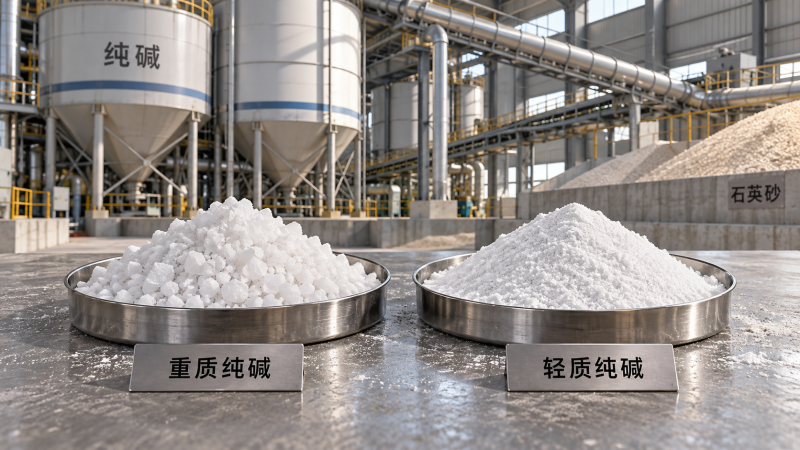
Dense and light soda ash both supply sodium carbonate to a glass batch. Their main difference is physical: dense soda ash generally has a higher bulk density and a coarser particle structure, while light soda ash occupies more volume per tonne and tends to contain more fine particles. If composition is equivalent, neither grade provides more sodium oxide on a mass basis simply because it is denser.
Dense grade is often the more practical starting point for conventional dry glass batches because its handling characteristics can be compatible with granular sand and automated conveying systems. Light grade remains a viable choice when the plant’s storage, dosing, dust control and mixing equipment can handle it consistently. The decision depends less on the grade name than on how a particular material behaves across the complete batch system.
The chemical contribution is similar; the physical behavior is not
Soda ash, primarily anhydrous sodium carbonate (Na2CO3), is used as a source of sodium oxide (Na2O) in many glass formulations. It participates in reactions with silica and other batch materials during heating, helping the batch form a melt at temperatures below those required for pure silica. Carbon dioxide is released as the carbonate decomposes and reacts.
For batch calculations, the useful comparison is the sodium carbonate assay or the supplier’s stated Na2O equivalent, not the apparent density. Pure Na2CO3 has a theoretical Na2O equivalent of about 58.5% by mass. Commercial products must be assessed using their actual assay and moisture basis. If two deliveries differ in assay, a mass-for-mass substitution changes the amount of sodium introduced, even when both are sold as soda ash.
Dense and light grades are broad commercial descriptions rather than complete performance specifications. Particle-size distribution, bulk density, moisture and impurity limits can differ between suppliers and production routes. A dense material from one source is not necessarily interchangeable with every other dense material without a review of those properties.
Batch uniformity depends on the whole particle system
The advantage of dense soda ash in many glass batches is not that a dense particle melts glass more efficiently by definition. It is that its particle characteristics can make it easier to handle alongside other granular ingredients. Sand, limestone, dolomite, cullet and soda ash all have their own size distributions, shapes and densities. During filling, discharge and transfer, differences between those properties can cause segregation, changing the local composition of the batch presented to the furnace.
A finer soda ash can disperse through a batch, but dispersion in a mixer does not guarantee uniformity after the mixture leaves it. Fine particles can become airborne at transfer points or concentrate in particular portions of the material as it moves through chutes and bins. Conversely, a coarse material is not automatically immune to segregation: large differences in particle size or density between any ingredients can still produce separation.
The practical question is where uniformity must be measured. A sample taken directly from the mixer may look acceptable while samples taken after a transfer chute or batch silo show greater variation. When comparing grades, sampling at both locations helps distinguish mixing performance from segregation introduced downstream. Sampling and preparation must be consistent; a small, non-representative grab sample can conceal the very variation under investigation.
Moisture management is another part of this comparison. Deliberate batch humidification can reduce dust and influence how particles adhere to one another, but its effect depends on the amount and distribution of water, mixer design and the complete formulation. Excess or uneven moisture can cause build-up, lumps or flow problems. A grade should therefore be assessed at the moisture conditions used in normal production, rather than only as a dry laboratory sample.
Dust is a process variable, not just a housekeeping issue
Light soda ash’s finer particles can generate more airborne dust during unloading, pneumatic conveying, bag opening and batch transfer. Dust formation depends on the material’s actual fines content as well as drop height, air movement, conveying velocity and enclosure design. Bulk density alone is not a reliable dust measurement.
Dust has several technical consequences. Material captured by extraction is no longer necessarily present in the batch at the intended proportion unless it is returned through a controlled process. If captured dust contains a different mixture of ingredients from the original batch, uncontrolled return can also change composition. Deposits around feeders and sensors can affect maintenance and measurement, while airborne alkaline dust requires appropriate exposure controls.
Dense grade can reduce the dust burden in a suitable system, but it does not eliminate the need for extraction or safe handling. Particles can break during transport and conveying, increasing fines before the material reaches the mixer. A useful specification may therefore include not only particle size at dispatch but also an agreed sampling point and method for checking the material on receipt.
Storage and dosing can determine whether a grade is usable
A lower bulk density means that the same mass of light soda ash requires more storage volume. That matters when silo capacity is fixed or when a pneumatic conveying line, receiving hopper or intermediate bin was designed around dense material. The relevant figure is the measured bulk density under a defined method, including whether it is loose or compacted. Compaction during transport or storage can change the apparent volume occupied.
Flow behavior cannot be predicted from density alone. Particle shape, fines, consolidation, bin geometry and ambient humidity all affect whether material discharges consistently. Poor flow can cause bridging, ratholing or erratic feed, while deposits and caking can develop if material is exposed to moisture. A silo that works with one grade should not be assumed to work equally well with another simply because both are sodium carbonate.
The dosing method changes the assessment. A gravimetric feeder measures mass, so it can compensate for a change in bulk density within its operating range. It cannot, however, correct for interrupted flow, an incorrectly sized feed device or material lost after weighing. A volumetric feeder delivers volume rather than directly measured mass; a grade change can alter the mass delivered at the same setting and requires recalibration. Filling times and feeder limits should be checked under both minimum and maximum production rates.
Storage trials should consider normal operating interruptions as well as continuous flow. Material may behave differently after sitting in a silo than during an uninterrupted laboratory discharge test. Where a change of grade is being considered, discharge consistency after a representative hold period is more informative than a single short flow test.
Impurities and moisture can matter more than the grade label
Glass quality requirements vary by product, furnace and formulation. A grade comparison should therefore separate physical suitability from chemical acceptability. Iron, chloride, sulfate and other constituents may be relevant depending on the glass composition and the plant’s impurity budget. Their effects cannot be assessed in isolation from contributions made by sand, cullet, other raw materials and the furnace atmosphere.
For example, iron can influence color and light transmission, which makes its allowable level especially important where optical properties are tightly controlled. Chloride and sulfate should be evaluated against the full batch and process requirements rather than treated as universally harmful at any detectable level. The appropriate limits are application-specific; “dense” and “light” do not establish them.
Moisture also affects both delivered mass and handling. If the assay is reported on a dry basis but the plant weighs material as received, the effective sodium carbonate input must account for water present. Certificates of analysis should make the reporting basis clear. The same applies to particle-size results: sieve limits, measurement method and sampling location are needed before two supplier data sheets can be compared meaningfully.
Consistency between deliveries is as important as a single compliant result. A material close to a specification limit may be acceptable in isolation but leave little room for variation elsewhere in the batch. A useful acceptance specification defines limits for the characteristics that affect the process and requires results for each lot, rather than relying solely on a generic data sheet.
How to compare grades without disrupting the furnace
A grade change is best treated as a controlled raw-material change, not merely a purchasing substitution. Begin by establishing a baseline for the existing material: assay, moisture, bulk density, particle-size distribution, feeder performance, dust collection behavior and batch uniformity. Record relevant furnace and glass-quality indicators over a representative period, recognizing that operating conditions and cullet composition can also affect those indicators.
Before a plant trial, compare the candidate material against equipment constraints. Check silo volume, discharge characteristics, conveying capacity, extraction capability and the operating range of weighing or feeding devices. Laboratory analysis can screen for obvious chemical or physical incompatibilities, but it cannot reproduce every handling condition in a full-scale system.
During a controlled trial, maintain the intended Na2O contribution by adjusting the weighed addition for any verified assay or moisture difference. Keep other batch variables as stable as practicable, and document any changes that cannot be avoided. Monitor material flow, feeder repeatability, dust accumulation and representative batch composition at points before and after transfers. Evaluate glass-quality and furnace indicators over a period sufficient for the system to respond; a short observation immediately after switching material may not reflect the effect of the new batch.
The trial outcome should be interpreted as a system result. A dust increase could arise from the candidate material, a conveying setting or a transfer point; inconsistent batch chemistry could reflect feeder calibration or segregation rather than chemical variation in the soda ash itself. If an issue appears, identifying its location and mechanism is more useful than attributing it immediately to the grade name.
Compare cost at the batch system, not only at the delivery point
A quoted price per tonne does not capture differences in assay, freight volume, handling losses or plant modifications. Where assays differ, a clearer starting point is the delivered cost per tonne of usable Na2O equivalent, calculated using the agreed as-received composition. That figure still needs to be considered alongside the cost of extraction, maintenance, storage capacity and any necessary changes to conveying or dosing.
Light grade can be a rational choice where the existing system is designed for fine material and its delivered economics are favorable. Dense grade can justify a higher purchase price where it reduces measurable dust losses or avoids changes to a granular batch line. Neither conclusion follows from bulk density alone. The stronger selection is the material that meets the glass chemistry specification and maintains a stable, controllable batch from receipt through furnace charging.
Send Us Your Inquiry Today