








News & Insights
Stay Informed. Stay Connected.
Send Us A Message
Dimethylformamide Solvent Selection: Purity and Moisture Limits
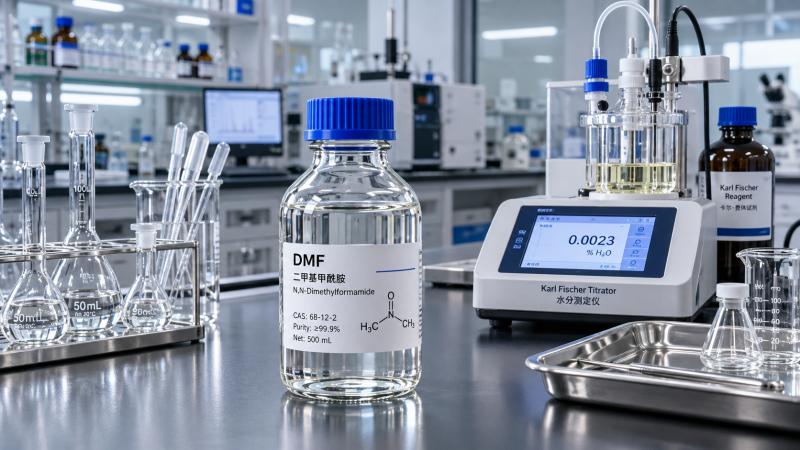
Selecting the right Dimethylformamide (DMF) solvent starts with a practical question: how much variation can your process tolerate? A high assay value is reassuring, but it does not tell the whole story. Water, acidity, amine-related impurities, residual solvents, and even the condition of the container can affect reaction performance or complicate downstream processing.
For technical evaluators, the objective is not automatically to buy the highest-purity material available. It is to define a solvent specification that protects the critical steps of the process, can be verified analytically, and remains achievable throughout routine supply. The following considerations can help turn a supplier’s certificate of analysis into a meaningful selection decision.
Start with the role DMF plays in your process
Dimethylformamide is a polar aprotic solvent used across chemical manufacturing, including pharmaceutical, pesticide, dye, and other synthesis applications. Its solvent properties can support reactions involving polar compounds and a range of organic materials. Yet the specifications that matter most depend on what the solvent is doing.
In a moisture-sensitive synthesis, water may consume a reactive reagent or change the balance between the desired reaction and competing pathways. In crystallization or purification, a trace impurity may be more important because it carries through into the isolated product. For a formulation or washing step, appearance, color, or residue after evaporation may deserve greater attention than they would in an earlier reaction stage.
Map the points at which DMF enters the process, identify the quality attributes of the intermediate or final product, and consider how the solvent is removed. This gives you a basis for setting limits rather than accepting a standard grade name at face value. Terms such as “technical,” “high purity,” or “anhydrous” are useful descriptions, but they do not replace a numerical specification and an agreed test method.
Purity percentage: useful, but not a complete risk assessment
DMF purity is commonly expressed as a percentage, often determined by gas chromatography. A higher value generally indicates less material detected as non-DMF components under the stated method. However, two batches with the same reported purity can contain different impurities, with very different consequences for a particular process.
Consider the distinction between total impurity level and individual impurity identity. A small amount of an incompatible amine, for example, may be more consequential in a sensitive reaction than a larger amount of a less reactive impurity. Likewise, an impurity that co-elutes with a product or remains after solvent recovery can create an analytical or purification problem even when the overall assay passes.
When comparing certificates, check whether the reported purity is based on a chromatographic area percentage, a calibrated assay, or another calculation. Ask what the method detects, whether known impurities are individually quantified, and whether water is included in or assessed separately from the purity calculation. A figure reported to two decimal places should not be assumed to have the same meaning across different analytical methods.
Which impurities deserve closer attention?
- Water: Frequently controlled separately because it can influence reaction chemistry and is not necessarily captured adequately by a routine GC assay.
- Dimethylamine and other basic impurities: Potentially relevant where base-sensitive chemistry, odor, or impurity carryover is a concern. DMF can degrade under certain conditions, making handling and storage relevant to the impurity profile.
- Acidic impurities: Important for processes sensitive to acidity, corrosion, or changes in reaction selectivity. Confirm how acidity is expressed and measured.
- Other volatile organic impurities: Residual solvents or related organic compounds may affect product specifications, solvent recovery, or analytical results.
- Nonvolatile residue and metals: Relevant where evaporation leaves material behind, or where catalysts, electronic applications, or product quality require tighter control.
Not every process needs a separate limit for every item. The point is to identify which impurities have a plausible route to affecting your chemistry or final quality, then request data that can test that concern.
Setting a moisture limit that means something
DMF is hygroscopic: it can absorb moisture from the surrounding environment. A batch that meets a supplier’s water specification when packaged may have a different water content after repeated opening, transfer, or storage in unsuitable conditions. For this reason, the relevant limit is not only the value on arrival. It is the water content at the point of use.
Start by reviewing the most water-sensitive operation. Is DMF charged into a reaction with moisture-sensitive reagents? Is it used before a drying step, or after the last opportunity to remove water? Will it be exposed to humid air in a day tank? These questions establish where the specification needs to provide protection.
Where process knowledge is limited, compare batches or prepare controlled laboratory trials at different water levels. Measure the outcomes that matter: conversion, impurity formation, filtration behavior, or product quality. Use those results, along with analytical variability and expected moisture uptake, to set a defensible acceptance limit. Do not treat a supplier’s “typical” value as a guaranteed maximum.
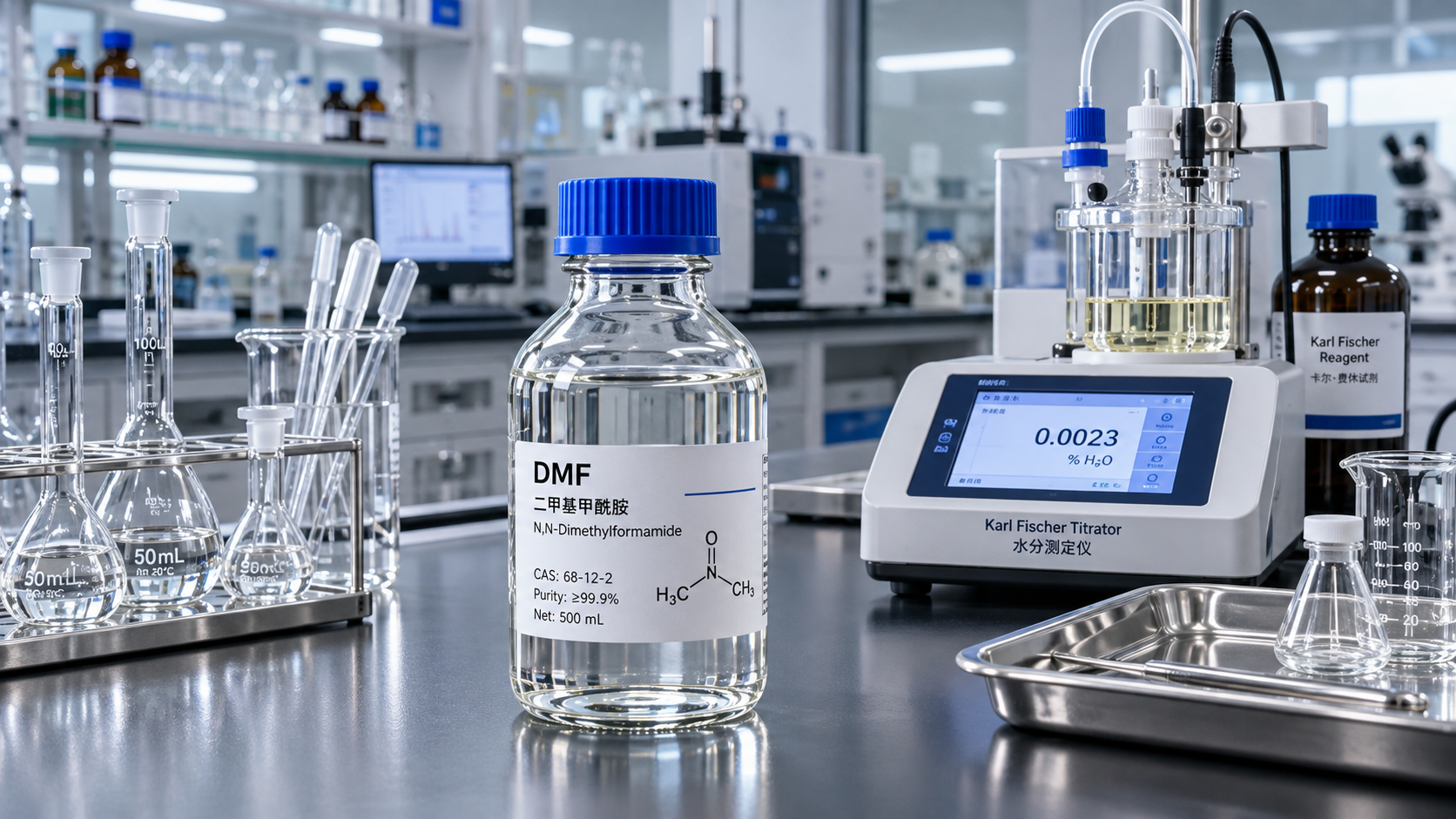
Karl Fischer titration is commonly used to determine water in organic solvents. When reviewing a result, confirm the method, reporting units, sample handling, and whether the method is suitable for the expected concentration range. If the process requires a particularly low limit, discuss detection capability and sampling precautions with both the supplier and your own laboratory.
Read the units before comparing limits
Moisture may be reported as a percentage or in parts per million by mass. For reference, 0.1% by mass equals 1,000 ppm by mass, while 0.01% equals 100 ppm. Ensure that the values use the same basis before comparing offers or entering specifications into a quality system. A misplaced decimal can turn an otherwise careful solvent qualification into a costly misunderstanding.
Compare grades using process risk, not labels alone
A grade with a tighter assay limit may be justified when trace organics affect a critical step. A lower moisture limit may matter more where the reaction is water-sensitive. In other situations, a well-controlled general-purpose grade may be sufficient. The decision should follow the demonstrated needs of the process, not the number of decimal places on a sales sheet.
What a useful certificate of analysis should show
A certificate of analysis, or CoA, is most useful when it connects a physical batch to defined acceptance criteria. Review the product identity, batch number, test results, specification limits, test methods or method references, and the date of analysis. Where a result is reported as “below detection” or “not detected,” request the applicable detection or reporting limit if that information affects your decision.
Distinguish clearly between a specification sheet, which states agreed limits, and a batch CoA, which reports results for the material supplied. A sample CoA can help assess the format and test coverage, but it does not establish the quality of a future delivery. For critical applications, discuss batch-to-batch consistency and the process for communicating changes in manufacturing, testing, packaging, or source.
It is also worth checking how the supplier treats out-of-specification results and retained samples. These details may seem secondary during initial purchasing, but they become important if a production batch behaves differently and the team needs to investigate quickly.
Qualifying Dimethylformamide before routine purchase
A sensible qualification program links document review to laboratory and, where appropriate, plant-scale evidence. Begin with a defined intended use and a draft specification. Obtain a representative sample with its analytical data, then verify the attributes that are critical to your process using suitable internal or qualified external methods.
Test the material in the actual application rather than relying only on a solvent assay. For a synthesis, that may mean tracking conversion and impurity profiles. For a purification step, examine recovery and carryover. If solvent recovery or reuse is planned, evaluate how water and impurities accumulate over repeated cycles; fresh-solvent data alone cannot establish the suitability of recovered DMF.
One successful trial is a useful starting point, not necessarily proof of long-term consistency. The number of batches and the extent of testing should reflect process risk and your organization’s qualification requirements. Document the acceptance criteria before the trial so that a purchasing decision is not based solely on whether the experiment “looked fine.”
Protect the specification after delivery
DMF quality can be affected by the journey from sealed container to reactor. Use suitable, clean, compatible containers and transfer equipment, and keep containers closed when not in use. Where moisture control is critical, assess exposure during sampling and transfer, as well as the suitability of any dry-gas blanketing arrangement. Establish storage and retest practices based on the supplier’s guidance, applicable regulations, and your own stability or use data.
Safety belongs in the selection discussion too. DMF presents significant health hazards, including potential absorption through the skin, and is classified as a reproductive toxicant in many jurisdictions. Review the current safety data sheet and local requirements; evaluate ventilation, closed handling, protective equipment, and exposure controls before introducing or changing a grade. Purity does not eliminate the need for safe handling.
Shandong Junzheng Chemical Co., Ltd. lists DMF among its chemical materials and serves industries including pharmaceuticals, pesticides, and dyes. When discussing a supply requirement, technical buyers can share the intended application, required purity and water limits, relevant impurity concerns, and documentation needs. Confirm the available grade, batch specifications, packaging, and supporting test information directly before qualification.
The strongest choice is the one that remains suitable beyond the purchase order: a DMF grade with limits tied to process risk, evidence that the limits are met, and handling controls that preserve those qualities until use.
Send Us Your Inquiry Today