








News & Insights
Stay Informed. Stay Connected.

Send Us A Message
Crude vs Refined Glycerol: Which Grade Suits Your Formulation?
Crude vs Refined Glycerol: Which Grade Suits Your Formulation?
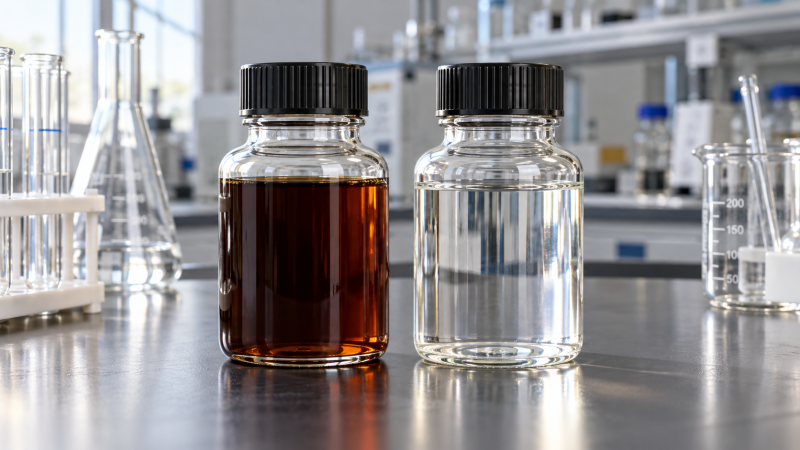
Choosing between crude and refined glycerol can affect formulation performance, processing requirements, and overall cost. Crude grades may contain variable levels of water, salts, and organic impurities, while refined grades offer greater purity and consistency. For technical evaluators, the right choice depends on the application’s tolerance for impurities, relevant specifications, and regulatory requirements. This guide examines the key differences to help you assess which grade fits your formulation.
The central question is not whether one grade is universally better. It is whether the material entering the process is sufficiently controlled for the job. A darker, variable feedstock may be acceptable in a process that already removes contaminants. The same material could create costly instability in a finished formulation where color, odor, or trace impurities matter.
What changes between crude and refined glycerol?
Glycerol, also called glycerin, is used as a humectant, solvent, plasticizer, and chemical intermediate. The molecule is the same regardless of grade; the practical differences are concentration, impurity profile, and how consistently those properties are controlled.
Crude glycerol is commonly associated with the production of biodiesel or other oleochemical processes. Depending on its origin and treatment, it can contain water, salts, residual alcohols, soaps, fatty materials, and other organic substances. Its appearance and composition can vary substantially between sources and even between batches from the same source.
Refined glycerol has undergone additional purification to reduce unwanted constituents. It is generally clearer and more consistent, but “refined” is not a complete specification. A material suitable for one industrial formulation is not automatically suitable for food, pharmaceutical, or another regulated use. The grade designation, applicable standard, test methods, and actual batch results all matter.
Start with the formulation’s impurity budget
A useful selection exercise begins with the finished product, not the supplier’s grade name. Identify what glycerol must do in the formulation, then determine which contaminants could interfere with that function.
For a water-based formulation, extra water from the raw material changes the total water balance. That may seem easy to correct, but an inconsistent water contribution can shift viscosity or solids content from batch to batch. If the glycerol acts as a plasticizer, changes in its actual concentration can also affect the effective dose and final material properties.
Salts and residual alkalinity deserve separate attention. They can alter ionic strength or pH, potentially affecting emulsions, dispersions, dyes, preservatives, or other sensitive ingredients. Organic residues may contribute odor, color, or incompatibility. None of these effects is inevitable: the risk depends on the impurity, its concentration in the finished product, and the chemistry of the formulation.
Where appearance and odor are customer-facing requirements, refined material is usually the more practical starting point. A crude feedstock may still be viable in an opaque intermediate or a downstream reaction, but only if its variable components are understood and the process can tolerate them.
When crude glycerol can make technical sense
Crude glycerol is most attractive when the process is designed around it rather than when it is treated as a simple drop-in substitute. Potential uses include chemical conversion or other industrial processes in which impurities are removed, consumed, or demonstrably tolerated. The economics improve when existing equipment can handle the relevant water, salts, and organic residues without compromising yield or product quality.
That qualification is important. Residual methanol, for example, can present safety and processing concerns; salt content can contribute to fouling or interfere with catalysts; and soaps or fatty residues may complicate separation. The actual risks depend on the feedstock and process. Do not assume a crude material contains any particular impurity at a particular level without testing.
A single successful laboratory batch is not enough to establish interchangeability. Ask how feedstock origin, upstream processing, and storage conditions may affect composition. Then test material representing the expected range of supply, including any high-impurity or high-water cases that the supplier can document. If those boundaries cannot be established, the apparent saving comes with an unpriced variability risk.
When refined grades justify the additional cost
Refined glycerol is often preferable when the finished product has tight requirements for clarity, odor, color, consistency, or trace contaminants. It is also a more defensible starting point when qualification documents must support an application-specific quality system.
For pharmaceutical, food, and certain personal-care uses, the relevant requirements depend on the intended use and destination market. A supplier may offer material described as meeting a pharmacopoeial or food-grade specification, but the buyer should verify the applicable current standard, documentation, and any additional requirements. A high glycerol assay by itself does not establish suitability or compliance.
Even for industrial use, higher consistency can have a measurable operational benefit. Fewer unexplained shifts in incoming raw material make it easier to investigate viscosity changes, color variation, or stability failures. That does not remove the need for incoming inspection; it makes the specification easier to manage.
Read the specification beyond the headline purity
The certificate of analysis should be assessed alongside the agreed product specification. The specification defines acceptable limits; the certificate reports results for a particular batch. A certificate that lists only glycerol content may leave critical questions unanswered.
Choose tests based on the formulation and feedstock risk. The following are common areas to discuss with a supplier or laboratory:
- Glycerol assay and water: Confirm the reporting basis and test methods so that dosage and water balance can be calculated correctly.
- Ash or inorganic residue: Use it as an indicator of residual inorganic material where appropriate, but do not assume it identifies individual salts or their effects.
- pH or acidity/alkalinity: Check the method and sample preparation; results are meaningful only when compared on a consistent basis.
- Color, odor, and appearance: Define acceptance criteria that reflect the finished product, not simply whether the sample looks acceptable in a container.
- Residual alcohols and other organics: Request relevant limits and analytical results where feedstock origin, process safety, or end use makes them important.
- Specific contaminants: Where required, address metals, diethylene glycol, ethylene glycol, or other substances using limits and methods appropriate to the application and applicable standard.
Detection limits matter as well. A result reported as “not detected” is only useful if the method can detect the substance below the relevant acceptance limit. If a property is critical but is not routinely tested, agree on how it will be verified before commercial use.
Compare cost on a usable-glycerol basis
A lower price per tonne of crude material does not necessarily mean a lower cost per tonne of glycerol delivered to the process. A straightforward first comparison is purchase price divided by the glycerol mass fraction. For example, if a material contains 80% glycerol by mass, one tonne contains 0.8 tonnes of glycerol before processing losses. Divide the delivered price by 0.8 to estimate the raw-material cost per tonne of contained glycerol.
That calculation is only the starting point. Add the costs of pretreatment, energy, analytical testing, handling, wastewater or residue disposal, and any process losses. If the material reduces usable yield or creates off-specification batches, those costs belong in the comparison too. Conversely, if an existing process can accept crude glycerol without modification, paying for a more refined grade may add little value.
The right comparison is therefore not crude versus refined at the loading dock. It is the cost and risk of producing an acceptable finished batch with each candidate material.
Qualify the supply as well as the sample
Once a grade looks promising on paper, run a controlled formulation trial. Keep the reference material, processing conditions, and analytical methods consistent. Test the finished product immediately and over a suitable storage period, paying particular attention to separation, viscosity, color, odor, and other attributes relevant to the application. For reactive systems, include yield, conversion, and catalyst performance where applicable.
Review more than one representative batch when variability is a concern. A pilot run can reveal issues that a small laboratory sample misses, such as pumping behavior, filtration demand, or deposits on equipment. Set acceptance limits before the trial so that the decision does not depend on whether a result merely looks close enough.
Supply logistics also affect material condition. Confirm packaging or bulk transport arrangements, container cleanliness, sealing, traceability, storage recommendations, and the documentation supplied with each shipment. Glycerol is hygroscopic, so exposure to ambient moisture can change the water balance; storage and sampling procedures should reflect that property. For crude grades, ask about phase separation and any precautions for obtaining a representative sample.
Shandong Junzheng Chemical Co., Ltd. lists glycerol among its chemical materials and describes technical, research, and quality-testing capabilities. When discussing a potential supply, the useful next step is to exchange the intended application, required specification, expected volume, and testing needs, then confirm which grade and supporting documents are available for that project.
Choose crude glycerol only after identifying how its impurity range will be controlled or accommodated. Choose a refined grade when consistency or application requirements warrant it, but verify the actual specification rather than relying on the label. In either case, a documented trial and an agreed incoming inspection plan turn a grade preference into a workable purchasing decision.
Send Us Your Inquiry Today