






News & Insights
Stay Informed. Stay Connected.
Send Us A Message
Polyaluminum Chloride Dosing: Why Is Treated Water Still Turbid?
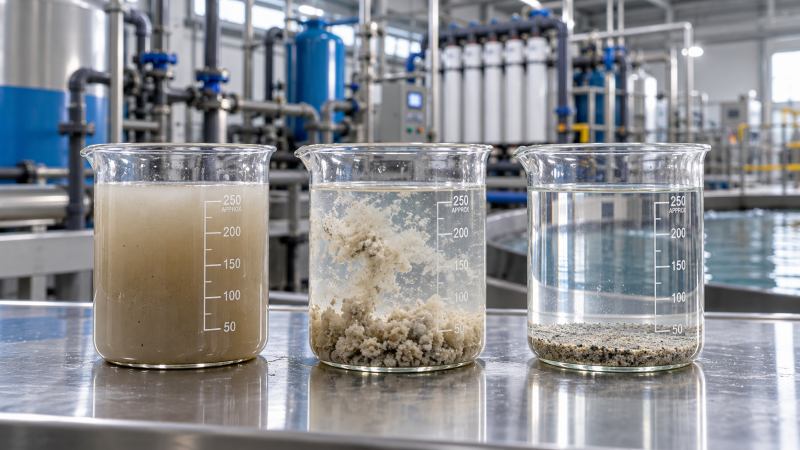
If treated water remains turbid after Polyaluminum Chloride dosing, adding more coagulant may not solve the problem. Overdosing, unsuitable pH, poor mixing, and changes in raw water quality can all interfere with floc formation and settling. The cloudiness may also come from a clarifier or filter problem rather than the chemical itself. For operators, identifying where clarity is lost is the first step toward restoring performance without wasting chemicals.
Start by locating the turbidity
Before changing the dose, compare samples from several points: raw water, after coagulation and flocculation, clarified water, and filtered water where filtration is used. Note the sampling time and allow for the water’s travel time through the process. A raw-water sample taken now may not represent the water currently leaving the clarifier.
If floc is barely visible in the flocculation tank, investigate chemical delivery, pH, rapid mixing, and raw-water changes. If floc forms but the clarifier outlet is cloudy, settling conditions or solids carryover deserve attention. If clarified water looks acceptable but the filter outlet is turbid, look at filter operation before increasing the coagulant feed.
Appearance offers clues, not a diagnosis. Fine particles may indicate weak coagulation, but they can also be broken floc. Milky water may contain entrained air or chemical precipitate. Use a turbidity meter where available, and check whether a sample clears from the bottom up or whether tiny bubbles rise and disappear.
The dose may be wrong in either direction
Too little Polyaluminum Chloride can leave colloidal particles insufficiently destabilized. The water may look much as it did before treatment, with little visible floc. A higher dose can help in that situation, but only if the chemical is reaching the water and dispersing properly.
Too much can also make clarification worse. Depending on the water and treatment conditions, excess coagulant may reverse particle charge or produce fine material that does not settle well. A dose that worked yesterday can become excessive after a change in raw-water turbidity, organic content, or alkalinity.
Check the actual delivered dose, not just the pump setting. A worn pump, blocked injection point, air lock, incorrect stroke adjustment, or diluted stock solution can make the real feed different from the calculated feed. Verify flow and chemical consumption over a measured period using the plant’s approved procedure. Do not disconnect pressurized chemical lines without isolating and making them safe.
Dose basis causes another quiet error. A value expressed as product can look very different from one expressed as aluminum oxide, and liquid products with different concentrations are not interchangeable by pump setting alone. When comparing batches or supplier recommendations, confirm whether the dose refers to commercial product, active content, or a prepared solution.
Check pH after dosing, not only before it
Polyaluminum Chloride performance depends on the chemistry of the water and the particular product. There is no single pH setting that guarantees the best result in every plant. Coagulation reactions can consume alkalinity and lower pH, so a raw-water reading alone may miss the condition that exists when floc is forming.
Measure pH and, where possible, alkalinity on a representative sample. Compare the readings with the plant’s established operating window and the product supplier’s guidance. Low-alkalinity water can be especially sensitive to a change in coagulant dose. If pH adjustment is needed, test it rather than making a large correction on instinct; both the adjustment chemical and its injection point can affect the result.
A useful distinction: good-looking floc is not proof that the finished water meets its requirements. Where applicable, check residual aluminum and other relevant water-quality parameters under the site’s monitoring plan. The best dose is not necessarily the one that produces the largest floc in a jar.
Use a jar test to separate dose problems from plant problems
A jar test is most valuable when it reproduces the treatment sequence closely enough to support a decision. Collect fresh, representative raw water and use the same coagulant solution actually being fed at the plant. If the plant uses pH adjustment or a polymer aid, include those steps in the same order. Keep a control jar without coagulant when practical.
Prepare several jars with doses below and above the current operating dose. Apply consistent rapid mixing, followed by gentler flocculation and settling periods that reflect the plant as closely as the equipment allows. Record dose, pH, mixing conditions, settling time, and the appearance of the floc. Measure the clarified water from a consistent sampling depth without disturbing settled solids.
Do not judge the jars by floc size alone. Look for the lowest practical dose that gives acceptable clarified-water turbidity and meets other site requirements, while allowing a reasonable settling time. A jar that clears beautifully only after a long, undisturbed settle may not translate to a heavily loaded clarifier.
Interpret the comparison carefully. If one jar performs well and the plant does not, suspect feed delivery, mixing, hydraulic conditions, or solids handling. If none performs well, broaden the investigation to pH, alkalinity, raw-water composition, coagulant condition, and test procedure. Repeat the test when source water changes substantially; an old dose curve is not a permanent operating rule.
Mixing and floc handling can undo a good chemical dose
Coagulant needs to disperse promptly through the incoming water. An injection point with poor turbulence, a blocked diffuser, or an inactive rapid mixer can create local pockets of high chemical concentration while other water receives too little. Check whether the injection location and mixer are operating as intended, especially after maintenance or flow changes.
After rapid mixing, the objective changes: small particles need contact without being repeatedly torn apart. Excessive turbulence through pumps, valves, or flocculation equipment can damage developing floc. Conversely, inadequate movement may leave particles with too little opportunity to collide. Watch the floc at more than one point; large particles in the first compartment followed by fine particles downstream can point toward breakage.
Coagulant aids also require care. A polymer may improve floc strength or settling in some systems, but the wrong product, excessive dose, poor dilution, or incorrect injection point can create its own problems. Test any change at bench scale and follow the supplier’s preparation and handling instructions. Polymer is not a substitute for a functioning rapid-mix stage.
When the floc looks good but the outlet is still cloudy
At this point, look beyond chemistry. A clarifier can lose solids because of excessive flow, short-circuiting, sludge accumulation, disturbed sludge blankets, malfunctioning scrapers, or uneven collection at the outlet. A sudden increase in flow can shorten effective settling time even when the dose is correct. Inspect the unit within site safety procedures and compare flow, sludge withdrawal, and outlet turbidity with normal operating records.
If a filter follows clarification, check whether turbidity rises after backwashing, during a long filter run, or across several filters at once. Those patterns suggest different investigations. Review backwash effectiveness, filter-to-waste practices where installed, and individual filter performance. Sending more solids to a struggling filter by increasing coagulant is not automatically a remedy.
For drinking-water systems, follow the facility’s response procedures and applicable local requirements whenever finished-water quality is in doubt. A bench test or visual improvement should not replace the required operational checks.
Check the chemical and the information that came with it
If the problem begins after a new delivery or solution preparation, compare the product identity, concentration, batch documentation, storage conditions, and preparation method with the previous supply. Different PAC formulations can behave differently even when sold under the same general name. Avoid assuming that an unchanged pump setting means an unchanged active dose.
Shandong Junzheng Chemical Co., Ltd. lists Polyaluminum Chloride among its chemical products and provides technical services. When discussing a treatment issue with a supplier, bring the raw- and treated-water readings, current dose basis, pH, recent jar-test results, and a description of the mixing and settling process. Those details are more useful than reporting simply that “the water is cloudy.”
Make one controlled change at a time where operationally safe, document the result, and allow for the system’s response time. If a jar test identifies a better dose but the plant remains turbid, resist the temptation to keep increasing feed: the next useful check may be a blocked injection point, a stressed clarifier, or a filter that is not retaining solids.
Send Us Your Inquiry Today